
23.11.2006, RC
To their Eminences /Excellencies, Presidents of the National Episcopal Conferences
CONGREGATIO DE CULTU DIVINO ET DISCIPLINA SACRAMENTORUM
Prot. n. 467/05/L
Rome, 17 October 2006
Vydávání Monitoru je financováno výhradně z dobrovolných darů Vás, čtenářů. Budeme vděční, pokud se rozhodnete Monitor podpořit darem, abychom mohli v této službě pokračovat.
Your Eminence / Your Excellency,
**In July 2005 this Congregation for the Divine Worship and the Discipline of the Sacraments, by agreement with the Congregation for the Doctrine of the Faith, wrote to all Presidents of Conferences of Bishops to ask their considered opinion regarding the translation into the various vernaculars of the expression pro multis in the formula for the consecration of the Precious Blood during the celebration of Holy Mass** (ref. Prot. n. 467/05/L of 9 July 2005).
The replies received from the Bishops' Conferences were studied by the two Congregations and a report was made to the Holy Father. At his direction, this Congregation now writes to Your Eminence / Your Excellency in the following terms:
1. A text corresponding to the words pro multis, handed down by the Church, constitutes the formula that has been in use in the Roman Rite in Latin from the earliest centuries. In the past 30 years or so, some approved vernacular texts have carried the interpretive translation "for all", "per tutti", or equivalents.
2. There is no doubt whatsoever regarding the validity of Masses celebrated with the use of a duly approved formula containing a formula equivalent to "for all", as the Congregation for the Doctrine of the Faith has already declared (cf. Sacra Congregatio pro Doctrina Fidei, Declaratio de sensu tribuendo adprobationi versionum formularum sacramentalium, 25 Ianuarii 1974, AAS 66 [1974], 661). Indeed, the formula "for all" would undoubtedly correspond to a correct interpretation of the Lord's intention expressed in the text. It is a dogma of faith that Christ died on the Cross for all men and women (cf. John 11:52; 2 Corinthians 5,14-15; Titus 2,11; 1 John 2,2).
3. There are, however, many arguments in favour of a more precise rendering of the traditional formula pro multis:
a. The Synoptic Gospels (Mt 26,28; Mk 14,24) make specific reference to "many" ([Greek word transliterated as polloin])) for whom the Lord is offering the Sacrifice, and this wording has been emphasized by some biblical scholars in connection with the words of the prophet Isaiah (53, 11-12). It would have been entirely possible in the Gospel texts to have said "for all" (for example, cf. Luke 12,41); instead, the formula given in the institution narrative is "for many", and the words have been faithfully translated thus in most modern biblical versions.
b. The Roman Rite in Latin has always said pro multis and never pro omnibus in the consecration of the chalice.
c. The anaphoras of the various Oriental Rites, whether in Greek, Syriac, Armenian, the Slavic languages, etc., contain the verbal equivalent of the Latin pro multis in their respective languages.
d. "For many" is a faithful translation of pro multis, whereas "for all" is rather an explanation of the sort that belongs properly to catechesis.
e. The expression "for many", while remaining open to the inclusion of each human person, is reflective also of the fact that this salvation is not brought about in some mechanistic way, without one's willing or participation; rather, the believer is invited to accept in faith the gift that is being offered and to receive the supernatural life that is given to those who participate in this mystery, living it out in their lives as well so as to be numbered among the "many" to whom the text refers.
f. In line with the Instruction Liturgiam authenticam, effort should be made to be more faithful to the Latin texts in the typical editions.
4. The Bishops' Conferences of those countries where the formula "for all" or its equivalent is currently in use are therefore requested to undertake the necessary catechesis of the faithful on this matter in the next one or two years to prepare them for the introduction of a precise vernacular translation of the formula pro multis (e.g, "for many", "per molti", etc.) in the next translation of the Roman Missal that the Bishops and the Holy See will approve for use in their country.
With the expression of my high esteem and respect, I remain, Your Eminence/Your Excellency, Devotedly Yours in Christ, Francis Card. Arinze, Prefect

23.10.2026, RC Monitor 19/2026
Občas se dívám na televizi, hlavně pozdě večer, když nemůžu spát, ale není to moudrý zvyk. Filmy nebo seriály jsou prošpikovány reklamami, které trvají tak dlouho, že zapomenete, na co jste se dívali. Jediné, co z tohoto zlozvyku dobrého vyplývá, že mohu, jak se dříve říkávalo, držet prst na tepu doby. Výmluvné jsou hlavně reklamy, kde účinkují děti.
21.10.2026, RC Monitor 19/2026
Kniha Genesis praví, že Hospodin přivedl k člověku všechna zvířata, aby viděl, jak je nazve. (Gn 2,19–20)

19.10.2026, RC Monitor 19/2026
Začnu příběhem, který se skutečně odehrál při jednání katolické pastorační rady. Jeden farník v nejmenované farnosti navrhl uspořádat mariánské říjnové pobožnosti. Dříve bylo zvykem konat je každý den, nicméně jeho návrh byl daleko skromnější. Šlo by pouze o čtyři pobožnosti – každou neděli jedna. Struktura by byla jednoduchá a tradiční: mariánská píseň, růženec, litanie a mariánská píseň. Když se onen farník zeptal, jak na tento návrh pohlíží farní rada, dočkal se odpovědi: „Velmi pesimisticky!“
Články e-mailem
Nové články přímo
do vaší e-mailové schránky
Čtrnáctideník Monitor
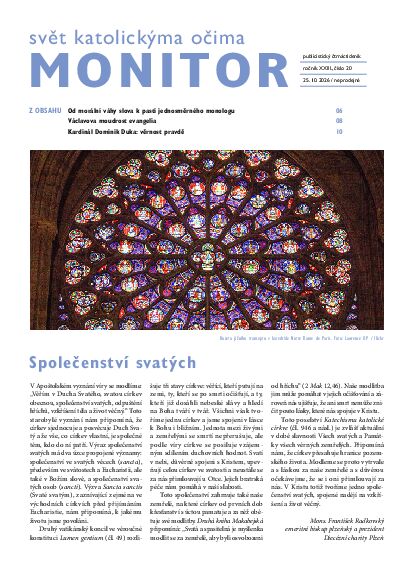
Tištěný publicistický čtrnáctideník Monitor bude ve vaší poštovní schránce každý druhý pátek. Zasílání je bezplatné a je hrazené výhradně z darů čtenářů.